OVERVIEW
Northern Circuit route is one of our preferred routes due to its low traffic, beautiful scenery and a high summit success rate.
This route starts off from the west, beginning with a long drive from Moshi to Londorossi Gate. From there, the first two days are spent trekking through the lush rainforest to Shira Plateau.
Northern Circuit joins the Rongai route at Third Cave Camp and then follows that route through the northern circuit and descending at Mweka Gate
ITINERARY
Day 1 Arrival
You will be picked up at the Kilimanjaro International Airport and transferred to your hotel in Moshi town, you will meet your guide who will brief you on your upcoming trek and do an equipment check to make sure you have all the necessary mountain gear. Gear which is missing can be rented on this day. Overnight: Parkview Inn (or alternative).
Meals: No Meals Included
Day 2 Lemosho Glades 2385m > Big Tree Camp (2780m)
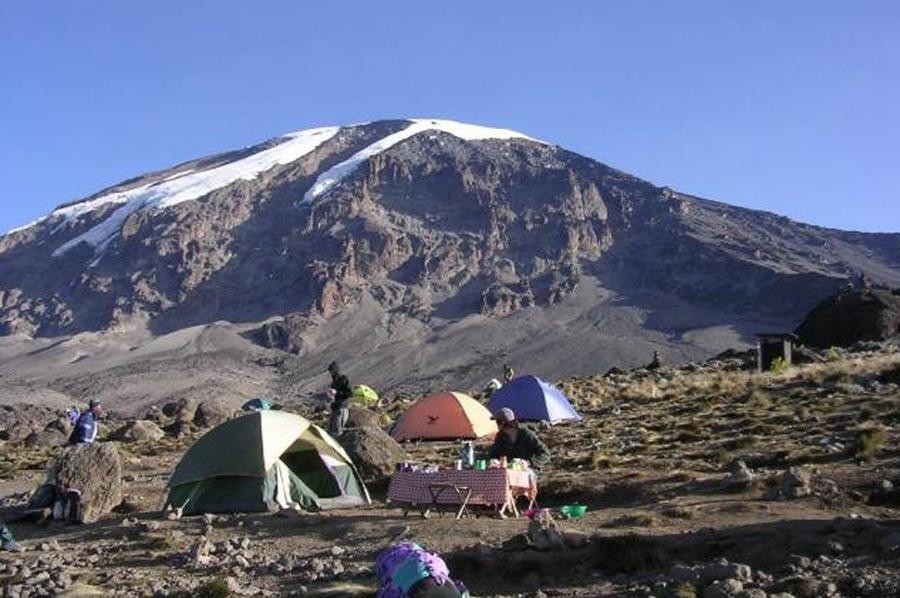
You will be picked up at your hotel at around 08:00am and transferred to the Lemosho gate located on the western side of Kilimanjaro. After the registration process you will still start our climb steadily through the forests of the Lemosho glades to reach Big Tree camp where you will be spending the night.
Distance covered: 7km / 4.3mi
Approx. time taken: 4 hours
Meals: Breakfast, Lunch & Dinner Included
Day 3 Big Tree Camp (2780m) to Shira 1 Camp (3500m)
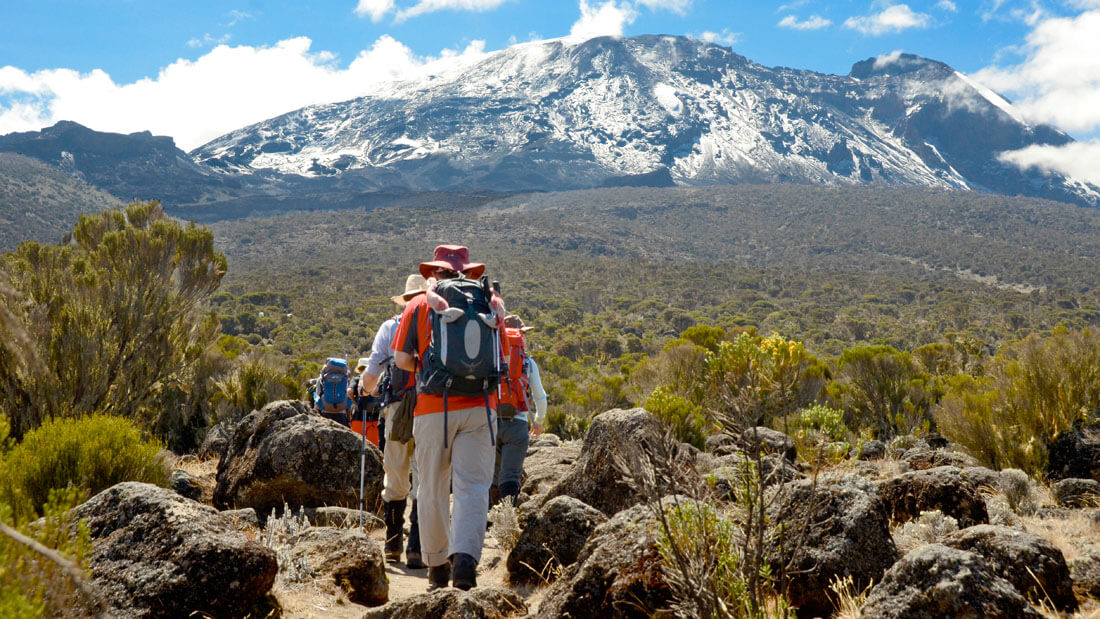
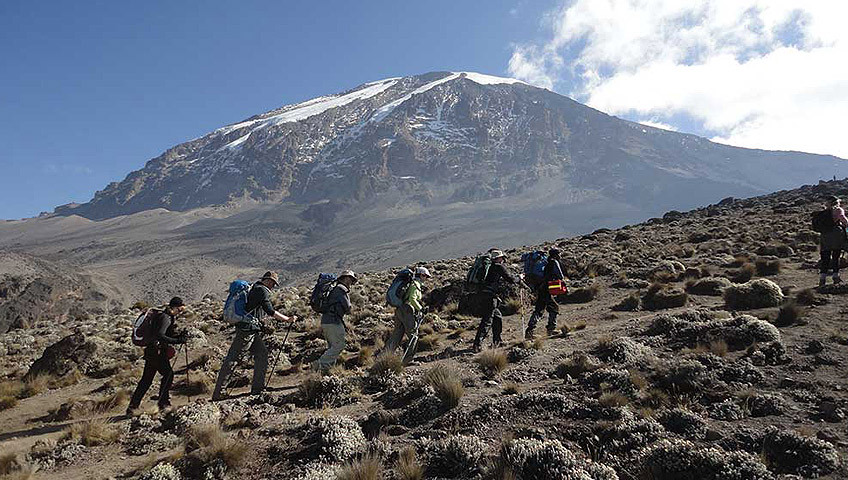
Today you will trek across a plateau of grassy moorland and heather scattered with volcanic rock formations. Our destination for today is the Shira 1 Camp from where there are often views of Kibo Peak floating on the clouds. We gain a reasonable amount of altitude today and parts of the route are fairly steep.
Distance covered: 8.5km / 5.3mi
Approx. time taken: 7 hrs
Meals: Breakfast, Lunch & Dinner Included
Day 4 Shira Camp1 3500m->> Moir Hut (4175m)
Today we have the chance to view the Northern ice fields from the western side of the mountain with some unusual views of Kibo. The terrain during our steady climb will change from the moorland of the Shira Plateau to the broad upland desert beneath the Lent Hills with great panoramic views. Our camp is close to Moir Hut (4175m). In the afternoon we do an acclimatization walk to the lower part of the Lent Hills group, to an altitude of 4300m.
10kms > 5-6hrs > Altitude gain 675m
Meals: Breakfast, Lunch & Dinner Included
Day 5 Moir Hut (4175m) to Pofu Camp (4,030 m)
We walk heading North to Moir Valley, we climb out of this to the summit of Little Lent Hill at 4,375m before striking eastwards around the Northern Circuit Trail and Finish our day at Buffalo/Pofu Camp.
12kms >4-5hrs >Altitude down 140m = Acclimatization Day = Afternoon
Meals: Breakfast, Lunch & Dinner Included
Day 6 Pofu Camp (4,030m) to Third Cave (3900m)
The day starts with a climb up heading east around the northern slopes to the Rongai Third Cave at 3,800 meters. The trek is shorter than the day before and by now you should be feeling well acclimatized to the altitude. You will arrive at the Third Cave just around mid-afternoon.
8kms >4-5hrs > Altitude down 50m
Meals: Breakfast, Lunch & Dinner Included
Day 7 Third Cave (3900m) to School Hut (4,750m)
We begin a day with a steady incline up and over the Saddle which sits between the peaks of Kibo and Mawenzi Peak. We then continue walking south-west up to School Hut (4,800 meters). After arriving at School Hut you will be served an early dinner and then you should get some shut-eye as you will be awoken before midnight to start your summit attempt. Remember to prepare all your gear, including warm clothes, insulated water bottles, snacks and headlamp before going to bed.
15kms>4-5hrs >Altitude gain 850
Meals: Breakfast, Lunch & Dinner Included
Day 8 School Hut (4750m) >> UHURU PEAK (5895m) >> Millenium Camp (3790m)
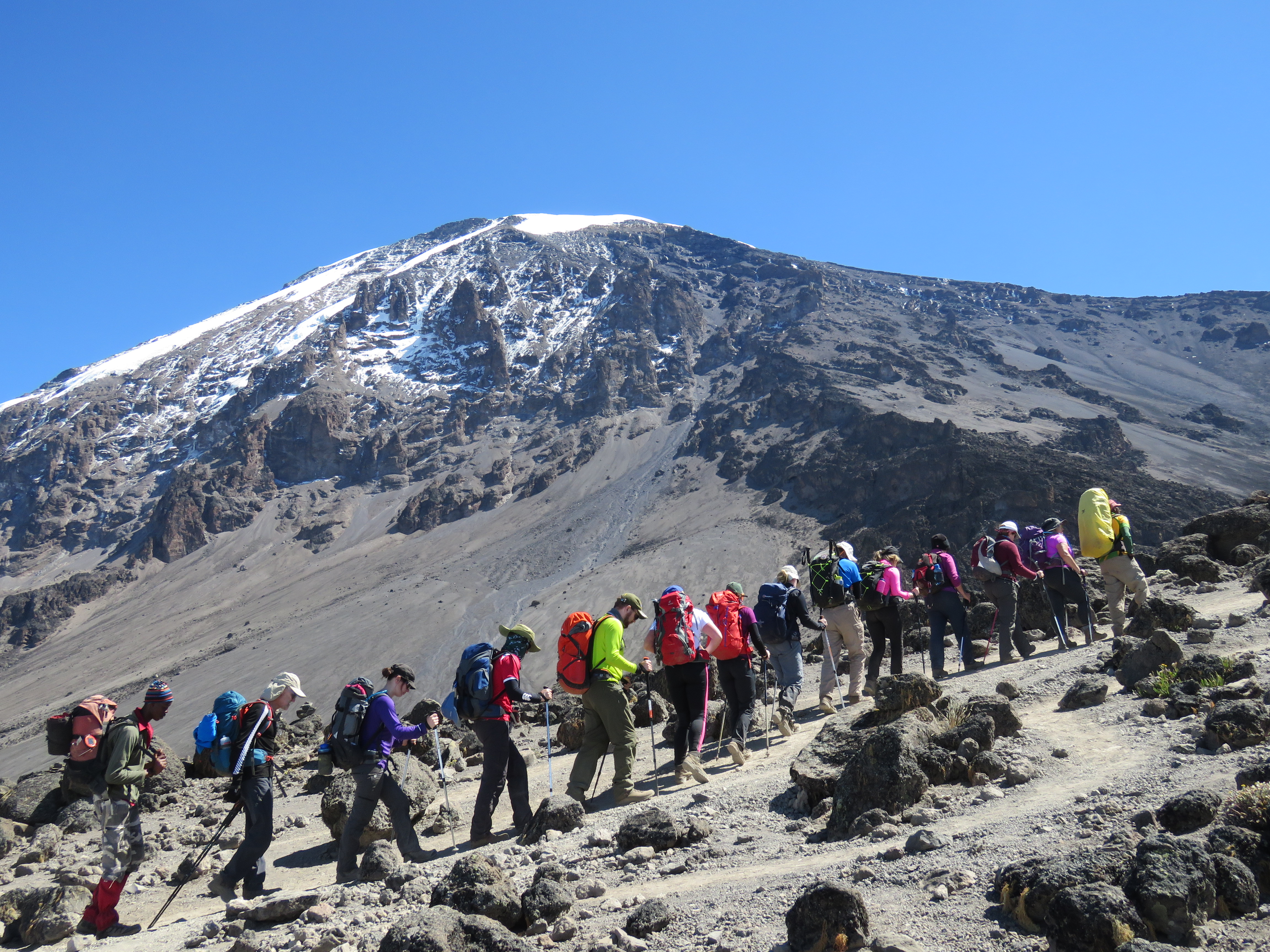
We start off at around midnight and walk steeply upwards to the summit glaciers. We will be climbing scree for 4 to 5 hours but gain incredible height over a short distance. The views are spectacular. We should be on the crater rim at Stella Point (5739m) as the first rays of the sun hit us. Spectacular ice cliffs within the crater surround us and the views to jagged Mawenzi peak and beyond are breathtaking.
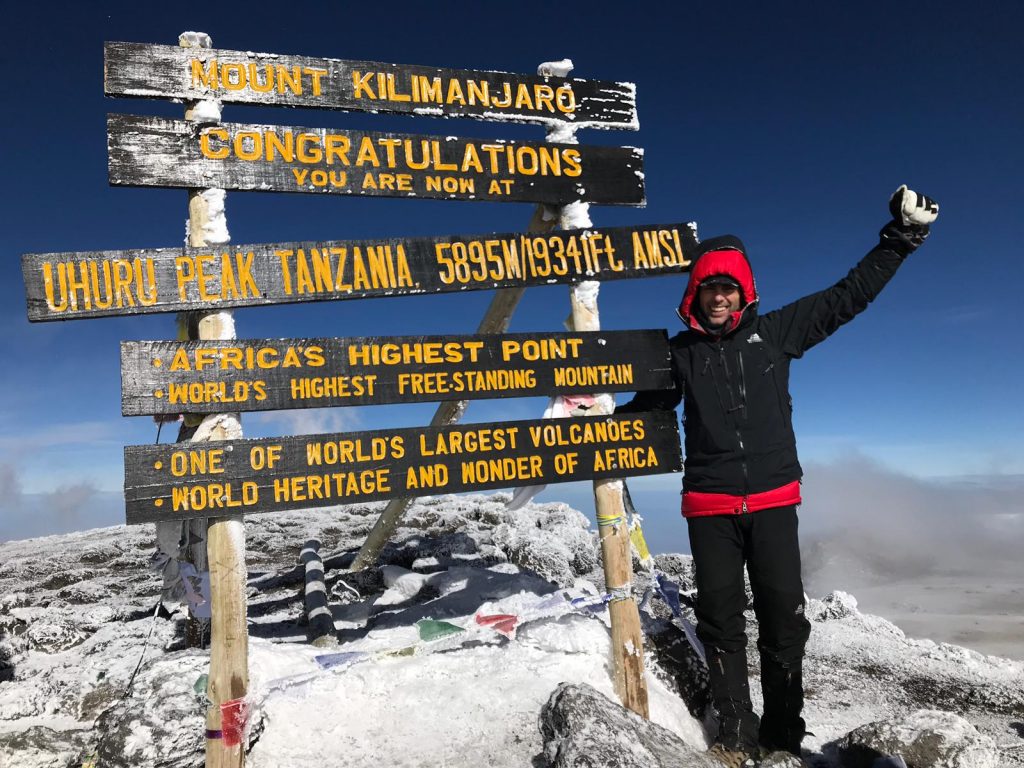
Another hour’s walking takes us to the summit, Uhuru Peak (5895m). We begin our descent by returning to Stella Point and then descending on scree slope and track back to Barafu Camp for breakfast, before finally heading down to Millennium Camp for a long well-earned rest.
School hut>>Uhuru Peak 6km/7hrs
Uhuru Peak>>Millenium Camp 9km/6hrs
Meals: Breakfast, Lunch & Dinner Included
Day 9 Trek Millennium Camp (3790m) to Mweka Gate (1630m)
A gentle trek takes us down through the rain forest to Mweka Gate, where we complete park formalities and receive certificates, which you can hang up with pride! We are then met by our vehicles and return to the hotel in Moshi, where you can treat yourself to a welcome shower (and a cold beer or two!) before our big celebration.
Overnight: Parkview Inn (or alternative)
Distance covered: 12.1km / 7.5mi
Approx. time taken: 6 hours
Meals: Breakfast & Lunch Included
TRIP INFORMATION
WEATHER
It is of course impossible to predict exact weather conditions, and mountains are notorious for creating their own, localized conditions. The highland areas of East Africa, including Northern Tanzania where Kilimanjaro and the parks of Ngorongoro, Tarangire and Lake Manyara are located, have a pleasant, temperate climate throughout the year. There is a long rainy season in April/May and a second, shorter rainy period in November/early December. Temperatures vary greatly with altitude. At the foot of Kilimanjaro it’s usually approximately 25- 28⁰C, dropping to 15⁰C at night. At 3000m, daytime temperatures can be around 15⁰C. Above 4000m, the night-time temperatures will fall below freezing and it is usually no more than 10⁰C in the day. For more information we recommend visiting www.worldweather.org
ALTITUDE RISK AND PRECAUTIONS
Mt. Kilimanjaro – also known as the “Roof of Africa” – stands 5,895 m above sea level and hence forms the highest freestanding mountain in the world. With a variety of landscapes at different altitudes, climbing the mountain is a truly exciting and unforgettable experience. Nevertheless, one should not overlook the fact that being exposed to high altitudes puts you at risk. Acute Mountain Sickness (AMS) or more commonly known as altitude sickness is one of the biggest threats when climbing Kilimanjaro
ACUTE MOUNTAIN SICKNESS
AMS is the result of a lack of air pressure on higher altitudes (and not as often said a lack of oxygen; the oxygen content in the air throughout the troposphere is always 20%). The air pressure decreases at about 10% with a gain of altitude of about 1000 m. Therefore, the air pressure on top of Kilimanjaro is only 40% compared to the air pressure at sea level. Consequently, every breath you take on your way up the mountain still contains 20% of oxygen but the air volume inhaled decreases because the atmosphere pushes less air and thus less oxygen into the lungs. A deficiency of oxygen can cause different malfunctions which in the end lead to AMS. Luckily, the human body can adapt to the changing oxygen level. This process is called acclimatisation and is the key to success on Kilimanjaro. While ascending you will automatically breathe deeper and faster. Moreover, your blood will thicken due to a higher production of red blood cells which ‘carry’ the oxygen all over your body. But these changes take time. Given the fact that most itineraries for climbing Kilimanjaro are construed as 5 to 7-day expeditions your body might not be given enough time to adjust to the lack of air pressure and the lower oxygen level. The consequence: AMS!
Mild AMS
Symptoms of mild AMS include headaches, nausea, sleeping problems and are often comparable to having a hangover. Pain killers should bring redemption. Suffering from a mild AMS does not mean that the trekker has to descend immediately. Nonetheless the trekker should rest at the current altitude and not ascend any further until the symptoms disappeared and a complete recovery can be assumed.
Moderate AMS
Moderate AMS is accompanied by vomiting, headache (pain killers at this stage won’t bring any relief) and a permanent feeling of being out of breath even while resting. The trekker can only continue the climb after an extended period of rest and a complete recovery from the symptoms.
Severe AMS
Most common when suffering from a severe AMS is a lack of coordination and balance (a condition known as ataxia) and mental confusion. Ataxia can easily be diagnosed. Draw a straight line on the ground, and have the trekker walk along the line, placing one foot immediately in front of the other, so that the heel of the forward foot is right in front of the toes behind. Try this yourself. You should be able to do it without difficulty. If they struggle to stay on the line (the high-wire balancing act), can't stay on it, fall down or can't even stand up without assistance, they fail the test and should be assumed to suffer from severe AMS. An immediate descent should undoubtedly be the consequence.
High Altitude Cerebral Edema – HACE
HACE is a life-threatening and thus very severe form of AMS and is a condition in which the liquid around the brain is built up. This build-up causes a persistent headache, vomiting, ataxia, changes in mentation and behaviour, lethargy or in severe cases even unconsciousness. Immediate descent is the best treatment for HACE. This is of the utmost urgency and cannot wait until morning (unfortunately, HACE often strikes at night). Delay may be fatal. The moment HACE is recognised is the moment to start organising flashlights, helpers, porters, whatever is necessary to get this person down. Descent should be to the last elevation at which the sufferer woke up feeling well. Bearing in mind that most cases of HACE occur in persons who ascend with symptoms of AMS, this is likely to be the elevation at which the person slept two nights previously. If you are uncertain, a 500 to 1000 m descent is a good starting point. People with HACE usually survive if they descend soon enough and far enough and usually recover completely. The staggering gait may
persist for days after descent.
High Altitude Pulmonary Edema – HAPE
Another form of a severe and serious AMS is HAPE, the accumulation of fluid around the lungs causing excessive pressure on the lung arteries. A gurgling, liquid sound in the lungs, a persistent watery cough and pink phlegm or even blood are the consequences. Exertion and cold exposure can also raise the pulmonary blood pressure and may contribute to either the onset or worsening of HAPE. HAPE can be confused with many other respiratory conditions. High Altitude Cough and Bronchitis are both characterised by a persistent
cough with or without sputum production. But there is no shortness of breath at rest, no severe fatigue and normal oxygen saturations (for the altitude) will be measured if a pulse oximeter is available. Pneumonia can be difficult to distinguish from HAPE. The diagnostic test and treatment is descent - HAPE will improve rapidly with lower altitude. If the patient does not improve with descent a treatment with antibiotics should be considered. HAPE is much more common and unfortunately more dangerous at altitude than pneumonia.
Many climbers have died of HAPE when they were mistakenly treated for pneumonia. Asthma might also be confused with HAPE. Fortunately, asthmatics seem to do better at altitude than at sea level. In a tentative diagnosis of asthma, the corresponding asthma medication should be given. But if the person does not improve quickly, HAPE should be assumed and treated accordingly. Immediate descent is once again the treatment of choice for HAPE. Unless oxygen is available delay may be fatal. Descend to the last elevation where the sufferer felt well upon awakening. Moreover, for severe cases of HAPE there are different medications available which lower the pulmonary hypertensive response to the lack of oxygen. It is common for persons with severe HAPE to also develop HACE, presumably due to the extremely low levels of oxygen in their blood (equivalent to a continued rapid ascent). HAPE usually resolves rapidly with descent and one or two days of rest at a lower elevation may be adequate for complete recovery
TREATMENT OF SEVERE AMS, HACE AND HAPE
In severe cases of AMS, HAPE or HACE descent might not be sufficient for a recovery. Additional treatment must be considered. These treatments include oxygen, hyperbaric bag, Acetazolamide (Diamox®) and Dexamethasone (Decadron®).
Oxygen
Symptoms of severe AMS disappear when giving additional oxygen from a bottle or canister over an appropriate period. Although, in combination with an immediate descent, considered as the most effective treatment, oxygen is reserved for more serious cases of HACE and HAPE.
Hyperbaric Bag
The hyperbaric bag is a man-sized bag which is, once the victim is enclosed, inflated. This will then simulate an increasing air pressure as felt at lower elevations and therefore enables the sufferer to inhale more oxygen. To be effective, the bag has to be kept at a constant pressure.
Acetazolamide (Diamox®)
Acetazolamide supports/accelerates acclimatisation and reduces the symptoms of mountain sickness but the cure of AMS is not immediate. Acetazolamide is a diuretic. It forces the body to excrete excessive liquids which occur when suffering from HACE and HAPE.
There is a lot of mythology about acetazolamide:
MYTH: acetazolamide will prevent AMS during rapid ascent
This is not a myth, but rather a misused partial truth. Acetazolamide does lessen the risk of AMS. Even on acetazolamide, it is still possible to ascend so rapidly that when AMS strikes, it may be sudden, severe and possibly fatal.
MYTH: acetazolamide hides symptoms
Acetazolamide accelerates acclimatisation. As acclimatisation occurs, symptoms resolve, directly reflecting improving health. Acetazolamide does not cover up anything - if you are still sick, you will still have symptoms. If you feel well, you are well.
MYTH: acetazolamide will prevent AMS from worsening during ascent
Acetazolamide DOES NOT PROTECT AGAINST WORSENING AMS WITH CONTINUED ASCENT. Plenty of people have developed HAPE and HACE who believed this myth.
MYTH: If acetazolamide is stopped, symptoms will worsen There is no rebound effect. If acetazolamide is stopped, acclimatisation slows down to the body’s own intrinsic rate. If AMS is still present, it will take somewhat longer to resolve.
Dexamethasone (Decadron®)
Dexamethasone (Decadron®) is a potent steroid used to treat brain edema. Whereas acetazolamide treats the problem (by accelerating acclimatization), dexamethasone treats the symptoms (the distress caused by hypoxia). Dexamethasone can completely remove the symptoms of AMS in a few hours but it does not accelerate or support acclimatisation. If dexamethasone is used to treat AMS you should not ascend any higher until the next day to ensure the medication has worn off and is not hiding a lack of acclimatisation.
The Golden Rules
GOLDEN RULE I: If you feel unwell at altitude it is altitude illness until proven otherwise.
GOLDEN RULE II: Never ascend with severe symptoms of AMS.
GOLDEN RULE III: If you are getting worse (or have HACE or HAPE) descend at once
OTHER HEALTHY PROBLEMS
Colds and coughs are very common when climbing Kilimanjaro. A cough that produces mucus can have different causes. Most likely are the common cold or irritation of the bronchi due to cold air which produces symptoms that are like flu. It could, however, point to altitude sickness. A cough that produces thick green and yellow mucus could indicate a bronchitis. If it occurs together with chest pain (most severe when the patient breathes out), a high fever and blood-stained mucus, any of these could indicate pneumonia which requires a course of antibiotics.
Exposure, also known as hypothermia, can be caused by a combination of exhaustion, high altitude, dehydration, lack of food and not wearing enough warm clothes against the cold. Note that it does not need to be very cold for exposure to occur. Symptoms of exposure include a low body temperature, poor coordination, exhaustion and shivering. As the condition deteriorates the shivering ceases, coordination gets worse making walking difficult and the patient may start hallucinating. The pulse then slows and unconsciousness or even death follow shortly. Treatment involves thoroughly warming the patient quickly by using sleeping bags, warm/hot water in a bottle and the bodily warmth of a second person.
Frostnips, the first stage of frostbites, may occur if not kitted out properly with thick socks, boots, gloves and hats. However, severe frostbites which lead to the loss of fingers and toes rarely happen to trekkers on Kilimanjaro. In the case of fingers or toes getting cold and painful and then numb and white the application of warmth is the first treatment.
A twisted ankle, swollen knee or a septic blister on your foot can ruin a Kilimanjaro trek. Therefore, it is important to take care to avoid these. Comfortable boots with good ankle support, not carrying too heavy a load, washing feet and changing socks regularly, treating/covering blisters as soon as possible is recommended. In case of a sprained ankle, cooling and bandaging afterwards is the first-choice treatment in combination with Aspirin to reduce the pain and swelling. In order to avoid knee problems which occur especially while descending smaller steps should be made and hiking sticks should be used
REQUIRED MOUNTAIN CLIMBING EQUIPMENT
Muzuri Tours ensures that all clients are properly equipped to comfortably reach the top of Mt. Kilimanjaro. Prior to the arrival all clients receive a list of required equipment. During the in-depth pre-climb briefing the clients’ gear will be inspected by our guides to ensure it is suitable. In case of any missing or unsuitable items, Muzuri Tours works closely with local rental companies that will provide climbing equipment very quickly. Our company provides all necessary cooking and eating equipment as well as the camping gear for those clients who choose a camping route.
Required Mountaineering Equipment (non-exhaustive list)
- 1 Mountaineering Sleeping bag (usually a -10-degree rating or better is recommended)
- 1 litre water canteen (sturdy plastic or lightweight metal) or water bladder (Camel Bak).
- 1 LED Flashlight with spare batteries - or if you can get a wind-up one that is even better!
- 1 Pair of comfortable trekking/hiking boots
- 2 pairs of thick thermal socks and several pairs of regular socks
- 2 Fleeces
- 1 down jacket or long-sleeved wind-breaker (down jacket is unnecessary if you have a couple of good heavy fleeces)
- 1 set of thermal underwear (i.e. thermal vest & long-johns)
- 2 pairs of trekking trousers
- 1 waterproof jacket
- 1 pair of waterproof trousers
- 1 balaclava or ski-mask
- 1 pair of gloves
- 1 pair of hiking/walking poles
- 1 sun hat and sunglasses
- 1 duffle bag and 1-day pack
In addition, the clients’ day pack should contain the following items:
- Sunscreen, sun hat and sun glasses
- Poncho or lightweight waterproof
- Spare socks (in case you come across some wet weather and your boots get wet)
- Camera
- Energy Bars (optional, but great if you feel like having a nibble while you hike)
PHOTOGRAPHY
It is recommended that you do not photograph Tanzanians without their express permission. However, you will find that many people enjoy having their pictures taken especially if they can see the instant results of a digital image. If individuals do refuse to be photographed, please respect this decision
TIPPING IN TANZANIA
Tipping is not a common practice in Tanzania, with exception of the tourism industry. It is customary for visitors climbing Kilimanjaro or going on Safari to tip the guides and crew. This is discretionary and should depend on the level of service you received and be a mirror of your satisfaction of the professionalism of the team.
We strongly feel this should not depend on whether or not you reached the top. Whilst discretionary, many of our guests ask us for a guideline so we suggest the following percentages:
Kilimanjaro Expeditions: 10-15% of total sum shared across the crew
Safaris: 5-7% of total sum shared across the crew
Local Excursions: 10% of total sum shared across the crew
WHAT TO WEAR
Though Tanzania is a rather tolerant country, people tend to dress rather conservatively and it is a sign of respect that you dress the same. Women should never dress in what the local people might interpret as a provocative fashion. We recommend that skirts or shorts at or below the knees or long pants should be worn at all times. Spaghetti strap tops, halter tops, or tank tops are not worn by local women very often, but are definitely seen more now than they used to be. Tight fitting or revealing clothing should be avoided – mainly to avoid stares from local men rather than any other reason.
Men can wear shorts or trousers, although you will find the local men rarely wear shorts. It is also advisable that men avoid wearing sleeveless shirts. It can be rainy between November – April, so we’d suggest bringing a raincoat and a sweatshirt. At other times of the year, light cotton clothing is best for the heat, though you should be prepared and pack a light sweater just in case.
IMPORTANT DOCUMENTS
We recommend that you make 3 photocopies of each of the below documents; you should scan them and email them to yourself as well.
- Passport (valid for at least 6 months after your intended return date)
- Tanzania Tourist Visa (you can also get this at the airport in Tanzania)
- Flight Tickets or print out of e-ticket (please also email these to Muzuri Tours so we can keep copies together on your file)
- Travel insurance details (again please email to us)
- Check/Debit/Credit Card
- Vaccination records/certificates
We recommend that you make 3 photocopies of each of the above documents; you should scan them and email them to yourself as well. On your journey to Africa, you should keep one copy in your backpack, one in your day-bag and give one set to your parents or a friend back home (in case you need to contact them in case of an emergency). To be extra safe you should also bring with you photocopies of the following:
- Driver’s license from your home, and international license if you have one
- Your embassy phone number in the countries you will be visiting
- Serial number on valuables e.g. cameras
- Credit card numbers & emergency numbers to report theft
INSURANCE
It is strongly recommended you secure travelers insurance for your upcoming trip and if climbing Kilimanjaro with us, be sure to include this additional coverage. The nearest hospitals of western standards for severe and life-threatening emergencies are located in Nairobi. For a minimal fee we can arrange Emergency Air Evacuation coverage to be transferred via helicopter to accredited facilities. Medical evacuations often cost tens of thousands of US Dollars
There are many options for this, including AMREF Flying Doctors, Air Med, Medjet Assistance, International SOS, Patriot Travel Medical Insurance and Foreignsure. Before your trip, we recommend that you consult with an insurance provider about these and other options to decide what is best for you.
As a developing country, health care costs are considered fairly low for local and basic services, and International travelers usually have to pay cash for any required medical care during travel. Few places will bill your home health insurance direction. And many health insurances plans do not cover medical care outside of your home country
PHOTOS
https://backup.muzuri-tours.com/index.php/muzuri-tours-kilimanjaro/kilimanjaro-trekking/9-days-northern-circuit-route?print=1&tmpl=component#sigProIdfd800beb6f